<?xml version="1.0" encoding="UTF-8"?>
<feed xmlns="http://www.w3.org/2005/Atom">
   <title>Kanada&apos;s Research Topics</title>
   <link rel="alternate" type="text/html" href="https://www.kanadas.com/research-topics-e/" />
   <link rel="self" type="application/atom+xml" href="https://www.kanadas.com/research-topics-e/atom.xml" />
   <id>tag:www.kanadas.com,2022:/research-topics-e//10</id>
   <updated>2015-03-05T14:52:30Z</updated>
   <subtitle><![CDATA[In this blog, I will write topics that spread among two or more research themes.  The research themes in my company are described, but I write them as a research scientist and my company has no concern to these descriptions.  
See Purpose of this blog for detail. 
If you do not want to publish your comment, send it to yasusi&nbsp;@&nbsp;kanadas.com
]]></subtitle>
   <generator uri="http://www.sixapart.com/movabletype/">Movable Type 3.36</generator>

<entry>
   <title>Trinity = Information + Electronics + Mechanics</title>
   <link rel="alternate" type="text/html" href="https://www.kanadas.com/research-topics-e/2015/03/trinity_information_electronic.html" />
   <id>tag:www.kanadas.com,2015:/research-topics-e//10.7536</id>
   
   <published>2015-03-05T14:52:13Z</published>
   <updated>2015-03-05T14:52:30Z</updated>
   
   <summary> By combining information technology and...</summary>
   <author>
      <name></name>
      
   </author>
   
   
   <content type="html" xml:lang="en" xml:base="https://www.kanadas.com/research-topics-e/">
      <![CDATA[<p>
By combining information technology and science, electronics, and mechanics, we can probably realize &lt;something&gt; completely new. A scholarship that combines the above three can be called "Trinity 
Engineering" or "Trinity Science". 
By using relatively recently enabled tooles such as CAD and 3D printers, one can create new things personally or by a small group. 
This creation is manufacturing and research at the same time.
</p>]]>
      
   </content>
</entry>
<entry>
   <title>Natural-Direction-Consistent 3D-Design and -Printing Methods (self-explanatory version)</title>
   <link rel="alternate" type="text/html" href="https://www.kanadas.com/research-topics-e/2013/08/naturaldirection_consistent_3d.html" />
   <id>tag:www.kanadas.com,2013:/research-topics-e//10.7050</id>
   
   <published>2013-08-17T22:28:27Z</published>
   <updated>2013-12-06T06:36:13Z</updated>
   
   <summary>[日本語版] I presented a poster titled “A Me...</summary>
   <author>
      <name></name>
      
   </author>
   
   
   <content type="html" xml:lang="en" xml:base="https://www.kanadas.com/research-topics-e/">
      <![CDATA[[<a href="/research-topics-j/2013/12/naturaldirectionconsistent_3dd.html" target="_blank">日本語版</a>]
<p>
I presented a poster titled “A Method of 3D Printing which is Consistent with Natural Direction in Shape”, in <a href="http://utwired.engr.utexas.edu/lff/symposium/" target="_blank">SFF Symposium</a> <a href="http://utwired.engr.utexas.edu/lff/symposium/documents/2013_SFF_Program.doc">2013</a>. 
<a href="/papers-e/2013/08/a_method_of_3d_printing_which.html" target="_blank">The poster</a> is not sufficiently self-explanatory, so a more self-explanetory version is presented here.
</p>]]>
      <![CDATA[<p>
<strong>Abstract</strong>: Usually, objects are horizontally sliced when printed by 3D printers. Therefore, if an object to be printed, such as a collection of fibers, originally have natural direction in shape, the printed direction contradicts with the natural direction. By using proper tools, such as field-oriented 3D paint software, field-oriented solid modelers, field-based tool-path generation software, and non-horizontal FDM 3D printers, the natural direction can be modeled and objects can be printed in a direction that is consistent with the natural direction. This consistence results in embodiment of momentum or force in expressions of the printed object. To achieve this goal, several design and manufacturing problems, but not all, have been solved. An application of this method is (Japanese) 3D calligraphy.
</p>

<a href="/papers-e/2013/08/a_method_of_3d_printing_which.html" target="_blank">Original poster</a>

<h3><big>1. Problem to Solve</big></h3>

<p>
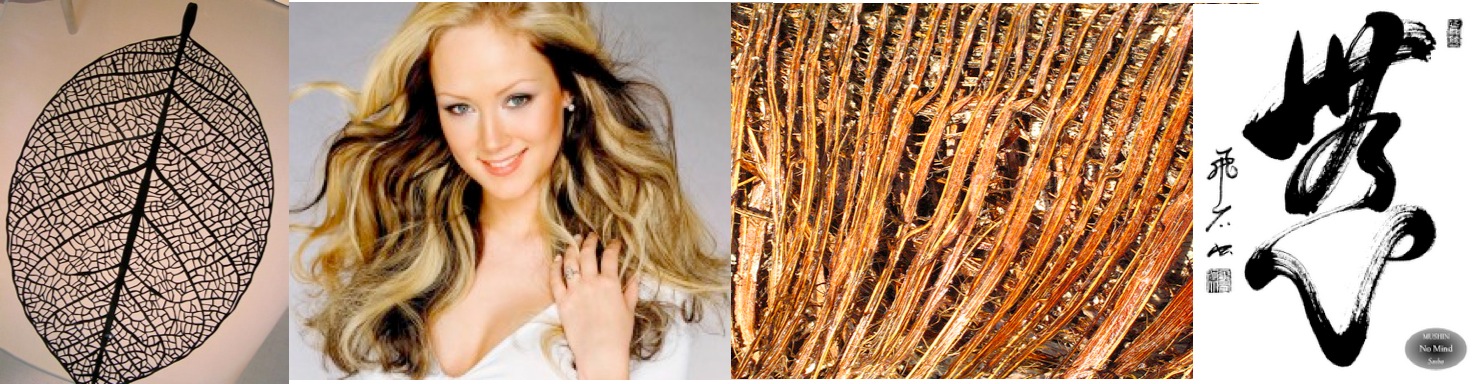
An object to be printed, such as a collection of fibers, may have “natural direction” in shape.      
See Figure 1. 
A leaf has leaf veins, each of which has a natural direction. 
Each part of human hair and Chinese or Japanese calligraphy also have a natural direction too. 
</p>
<p>
<img alt="fig01.jpg" src="/research-topics-e/fig01.jpg" width="740" height="192" />
<br />
Figure 1. Natural direction in shape
</p>
<p>
However, the printing direction of fused deposition modeling (FDM) 3D printers, which is most popular 
in cheaper 3D printers, may contradict with the  “natural direction” 
because the print head always run horizontally. 
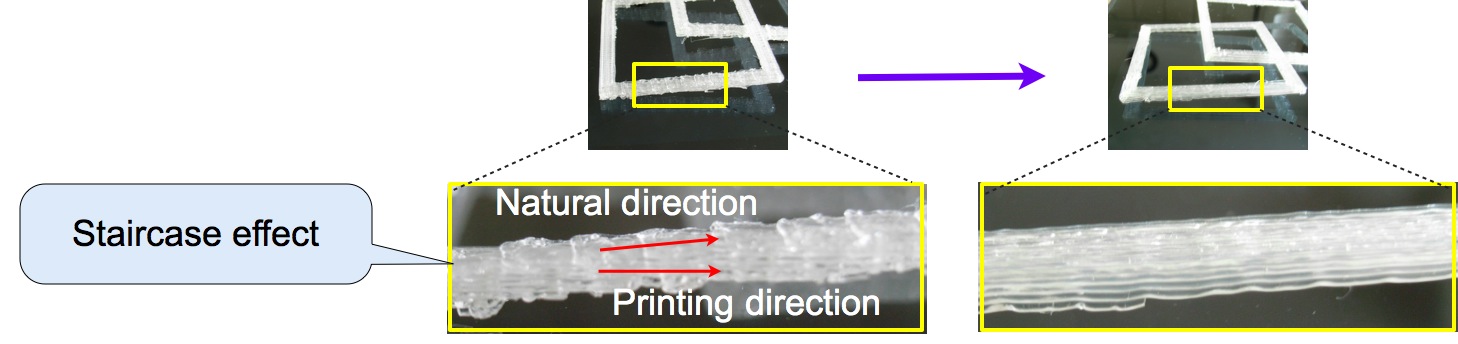
This contradiction causes so-called  “staircase effiect”, and 
both the shape and the intensity of the printed object are not good. 
See the left half of Figure 2. 
The shape should be similar to the right half of Figure 2. 
</p>
<p>
<img alt="fig02.jpg" src="/research-topics-e/fig02.jpg" width="729" height="172" />
<br />
Figure 2. Printing direction vs. natural direction
</p>

<h3><big>2. “Field” Based Solution</big></h3>

<p>
To solve the above problem, a “field” based solution is proposed here. 
To model objects with “natural directions”, and to slice and to print objects in the “natural direction”, 
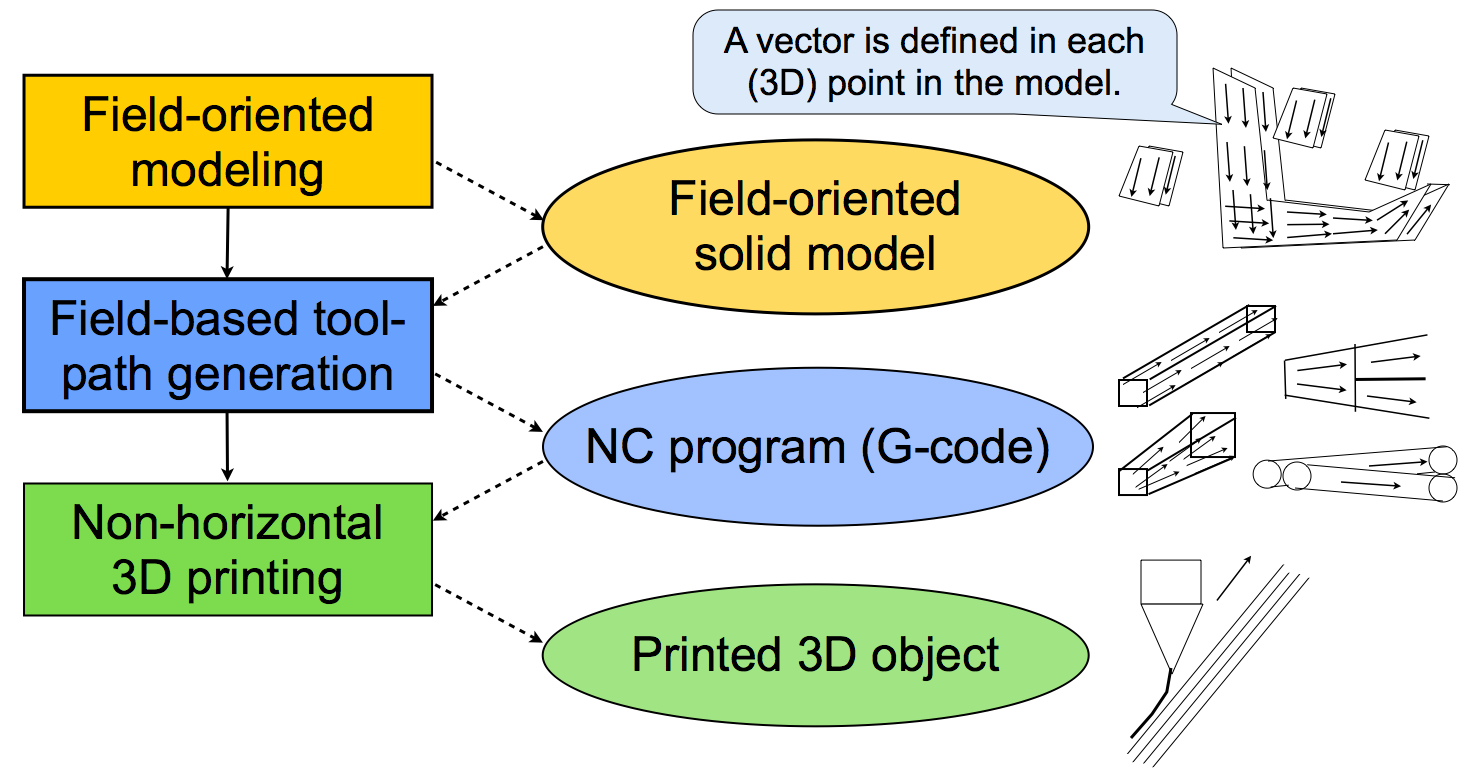
objects are designed and printed following the three steps below (see Figure 3). 
</p>
<ol>
<li>Field-oriented modeling
</li>
<li>Field-based tool-path generation
</li>
<li>Non-horizontal 3D printing
</li>
</ol>
<p>
<img alt="fig03.png" src="/research-topics-e/fig03.png" width="730" height="386" />
<br />
Figure 3. Three steps for natural-direction 3D printing
</p>
<p>
The field-oriented modeling outputs field-oriented solid model, which is an extension of 
conventional solid model. A vector is defined at each (3D) point in this model as shown in the figure. 
</p>
<p>
The field-based tool-path generation inputs a field-oriented solid model and outputs a normal NC 
program, such as a G-code based program. 
The algorithm of this tool-path generation is completely different from “slicing” algorithms 
in conventional 3D printing. 
</p>
<p>
By the non-horizontal 3D printing, an object with natural direction is created. 
This process may be performed by conventional 3D printer because a G-code program can 
express non-horizontal motions and conventional 3D printers may execute it correctly. 
</p>
<p>
The following three sections explain the above three steps. 
</p>

<h3><big>3. Modeling Methods</big></h3>

<p>
Two methods for field-oriented modeling are proposed here. They are 
field-oriented 3D CAD and field-oriented 3D painting. 
</p>

<h4><big>3.1 Field-oriented 3D CAD</big></h4>

<p>
Two methods for field-oriented 3D CAD are proposed. 
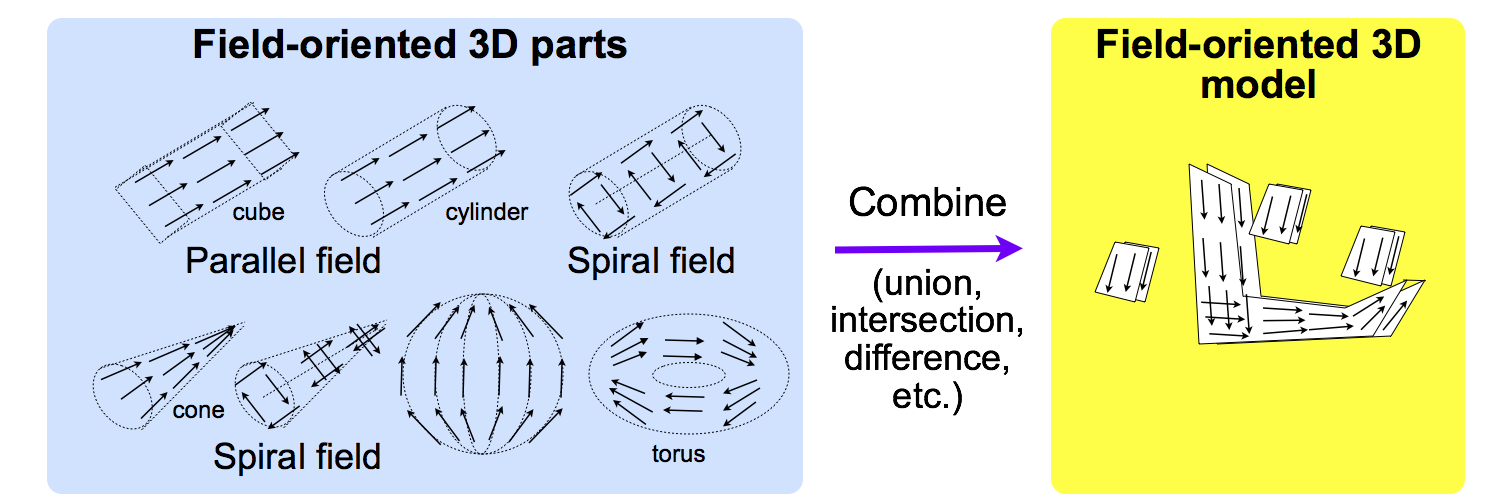
One method is “parts combination” shown in Figure 4. 
In this method, the designer combines 3D parts with “field” using a field-oriented 3D CAD tool. 
The combination operations are based on normal union, intersection, difference, and so on. 
However, these operations must define the methods of computing field from the fields in the parts. 
</p>
<p>
<img alt="fig04.png" src="/research-topics-e/fig04.png" width="756" height="249" />
<br />
Figure 4. Parts combination in field-oriented 3D CAD
</p>
<p>
The other method is “magnetization” shown in Figure 5. 
In this method, the designer first design normal 3D solid model using a conventional 3D CAD tool, 
and put the object in a field selected by the designer. 
When the designer specifies “copy field” operation, the field is copied into the object. 
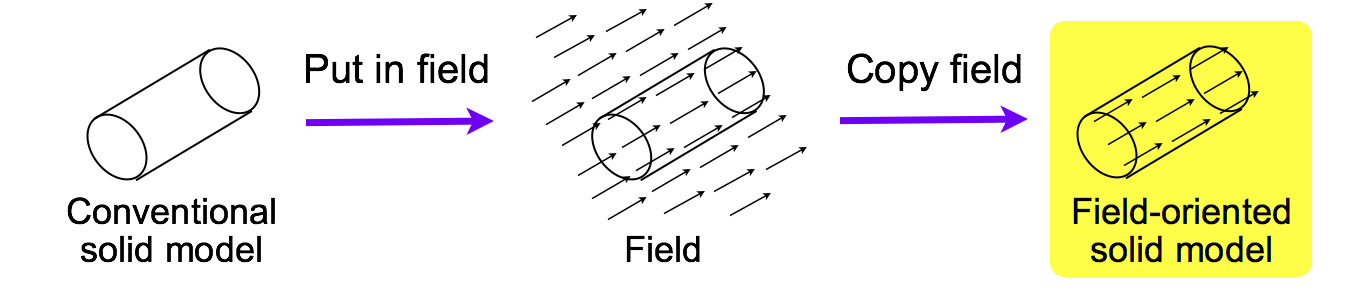
</p>
<p>
<img alt="fig05.png" src="/research-topics-e/fig05.png" width="677" height="146" />
<br />
Figure 5. Magnetization in field-oriented 3D CAD
</p>

<h4><big>3.2 Field-oriented 3D painting</big></h4>

<p>
Field-oriented 3D painting is analogical to 2D painting, which is widely used in personal computers. 
Similar to a 2D painting tool that uses 2D pointing device, a 3D painting tool uses 3D pointing device 
(see Figure 6). 
A human body tracking device, such as Microsoft Kinect, or sensors such as accelerometers used in 
Nintendo Wii can be used as 3D pointing device. 
The width and shape of the painting tool (such as 3D brush) can also be specified by human hand (fingers), in the case of a human 
body tracking, or pressure sensors, in the case of accelerometer-based method. 
In contrast to normal painting tools, field-oriented 3D painting tools record the direction of motion, and generate field vectors for each point in the painted object. 
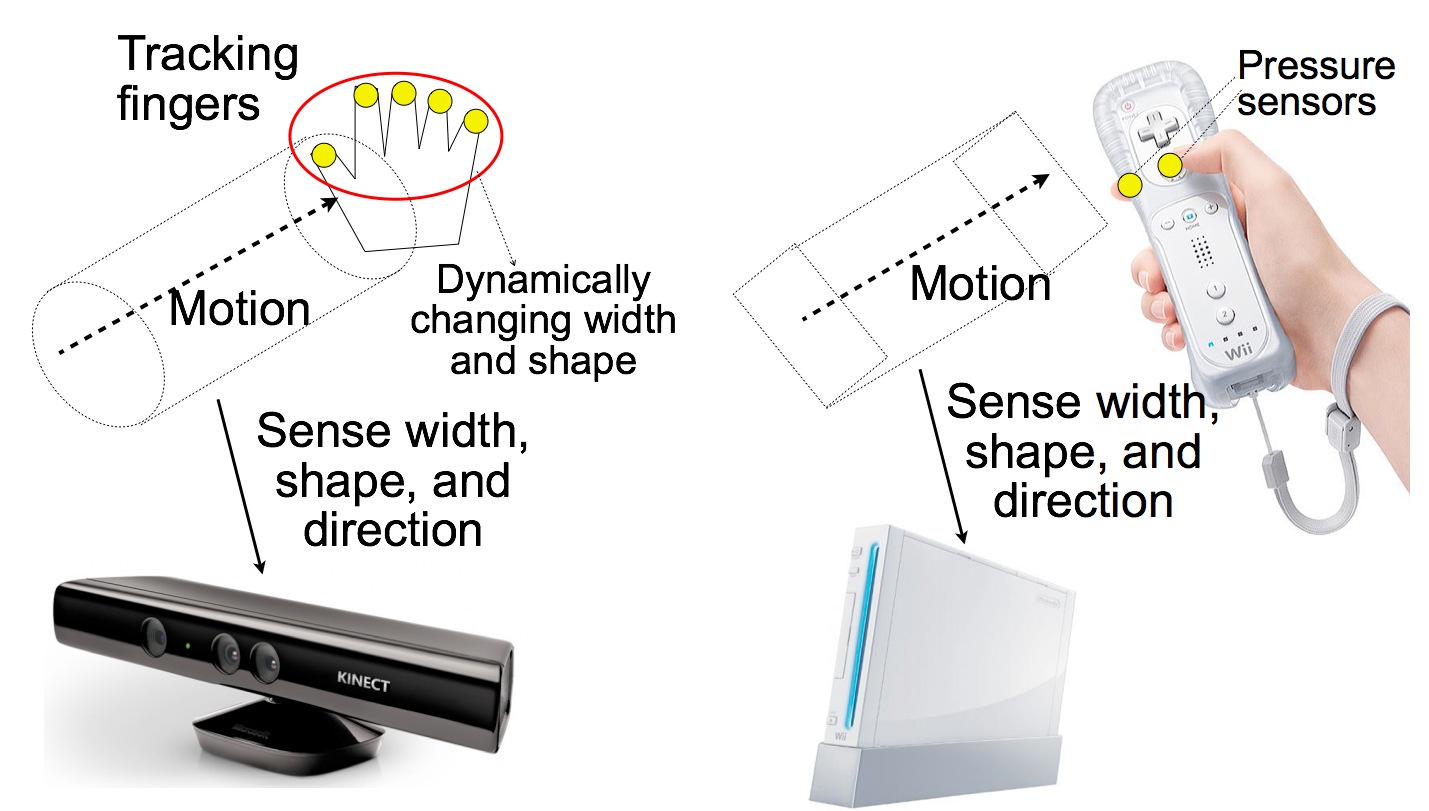
</p>
<p>
<img alt="fig06.jpg" src="/research-topics-e/fig06.jpg" width="715" height="406" />
<br />
Figure 6. Field-oriented 3D painting
</p>

<h3><big>4. Tool-path Generation Methods</big></h3>

<p>
A tool path for a 3D printer can be generated using the basic method described in Section 4.1. 
Several additional techniques are shown in Section 4.2.
</p>

<h4><big>4.1 Basic field-based method</big></h4>

<p>
In a tool-path generation process, an object is “hashed” along the field vectors as shown in Figure 7. 
This process is completely different from “slicing” in conventional 3D printing if the field vectors are 
not in parallel. 
If the object has parallel field as shown in the left half of Figure 7, the hashed object consists of strings 
that can be easily filled by constant extrusion of filament. 
However, if the field vectors are not in parallel, the strings may widening or narrowing as shown in 
the right half of Figure 7. 
In these cases, the amount of extrusion should be increased or decreased to fill the string. 
However, if the vectors are far from parallel, additional techniques are required. 
Several techniques for handling such situations  are described in the next subsection. 
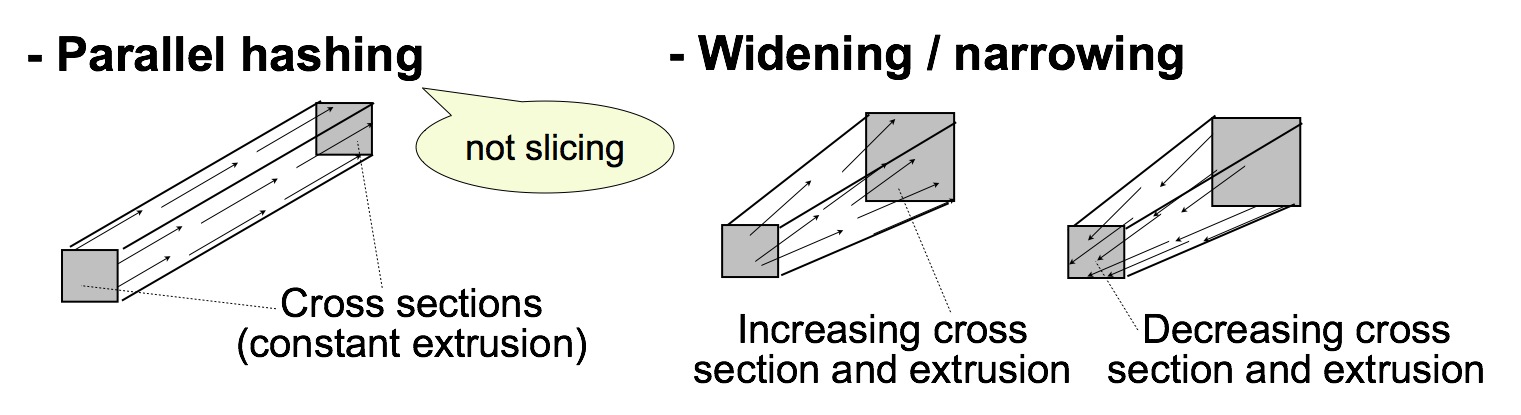
<p>
<img alt="fig07.jpg" src="/research-topics-e/fig07.jpg" width="761" height="208" />
<br />
Figure 7. Basic field-based tool-path generation method
</p>

<h4><big>4.2 Several techniques</big></h4>

<p>
If the cross section of strings change rapidly along the direction, the strings must be split or merged 
as shown in the left half of Figure 8. The photo included in Figure 8 shows two examples of 
split/merged object, which was printed by using Printrbot Plus, a 3D printer. 
If a string is vertically widening and horizontally narrowing, or vice versa, another method called 
twisting, can be applied (see the right half of Figure 8). 
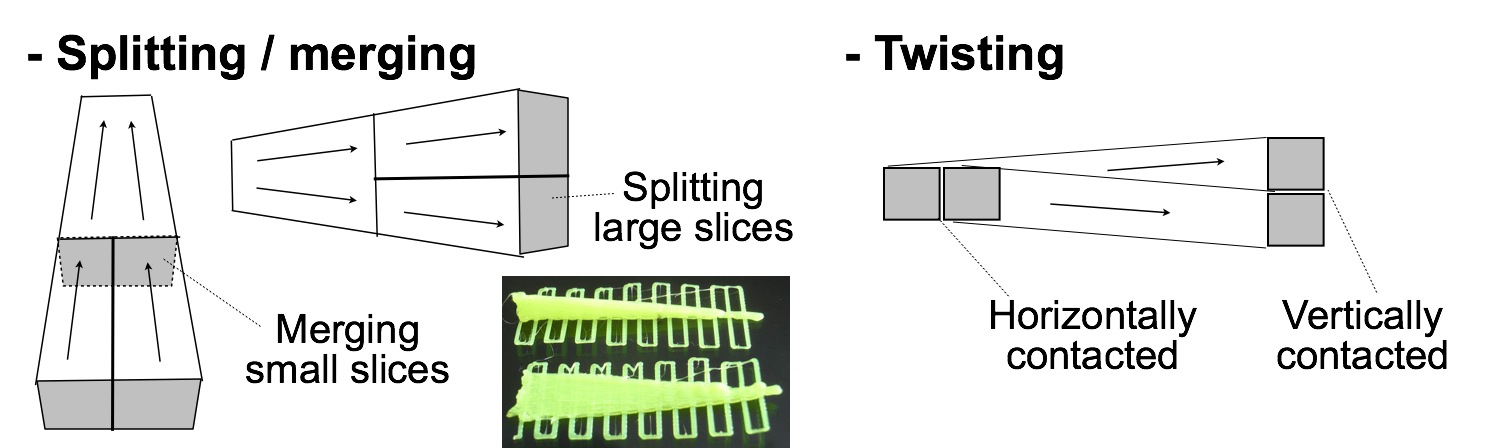
</p>
<p>
<img alt="fig08.jpg" src="/research-topics-e/fig08.jpg" width="751" height="224" />
<br />
Figure 8. Several techniques in field-based tool-path generation
</p>

<h4><big>4.3 Method for making unprintable objects printable</big></h4>

<p>
Similar to conventional CNC, some objects are not printable because of their shapes. 
The range of printable shapes in the natural-direction 3D printing is narrower than that of 
conventional 3D printing. 
However, the range can become wider by by changing printing order.
</p>
<p>
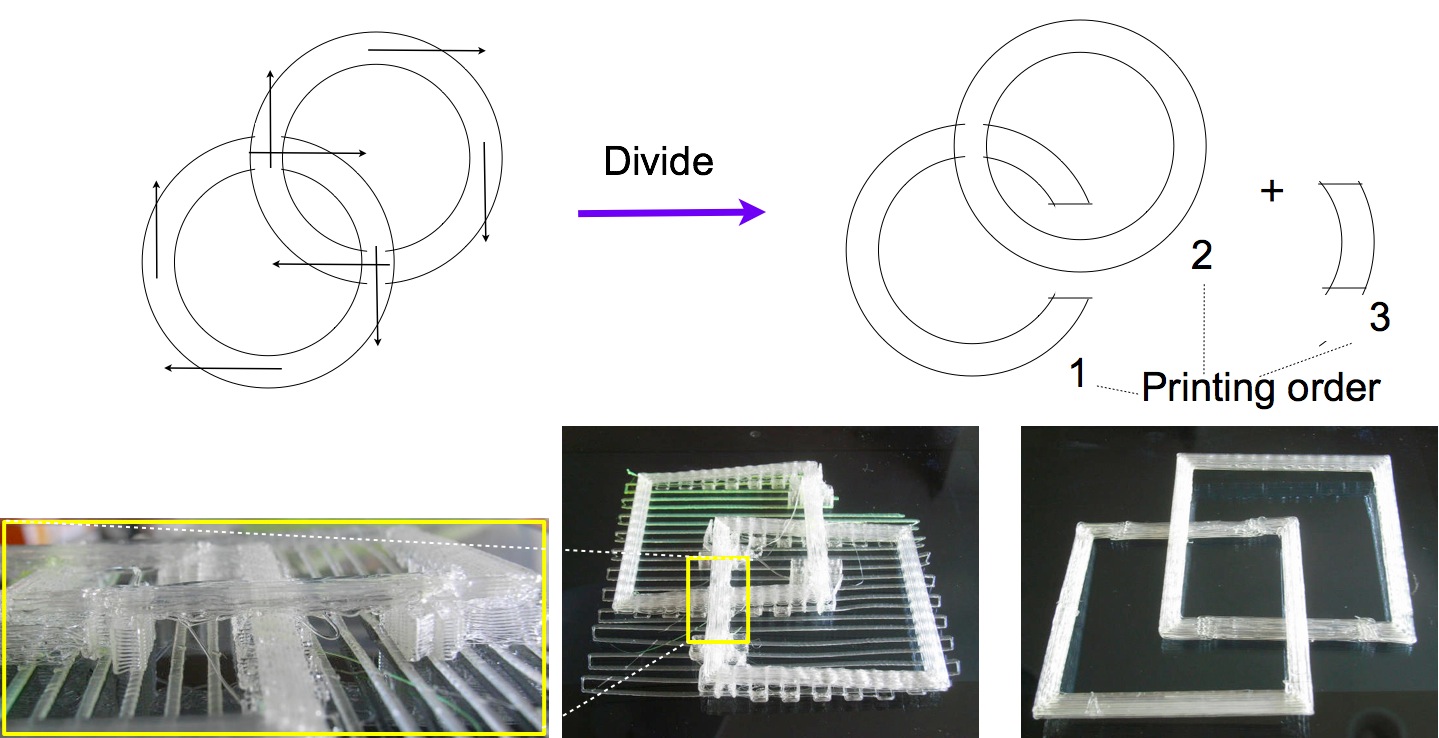
An example is shown in Figure 9. 
The upper-left figure shows the original shape, a chain with two rings, which is not printable. 
It becomes printable if one of the rings is divided into two parts and the printing order is changed 
as shown in the right figure. 
The photos below shows a rectangle version of this chain, which was printed in natural direction. 
Because there is currently no tool-path generator, the tool path for this chain was generated by a 
special-purpose program. 
The left photo shows the part 3 of this chain. 
<p>
<img alt="fig09.jpg" src="/research-topics-e/fig09.jpg" width="720" height="369" />
<br />
Figure 9. A method for making unprintable objects printable
</p>

<h3><big>5. Printing Techniques</big></h3>

<p>
Conventional 3D printers accept G-code for natural-direction 3D printing. 
However, they cannot print steeply. 
This section describes the problems and printing techniques to avoid it. 
</p>

<h4><big>5.1 Problems in steep printing     </big></h4>

<p>
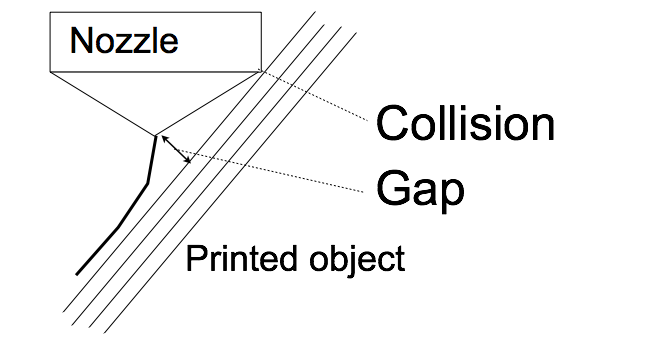
There are two problems that make steep printing difficult or impossible. See Figure 10. 
One problem is that, because conventional 3D printers are three-axis machines and they extrude 
only at the bottom, if they print in steep direction, they can collide with printed objects.  
The nozzle head thus cannot be sufficiently close to printing point. 
This means there is gap between the nozzle tip and the printing point. 
</p>
<p>
The other problem is that conventional 3D printers can not usually move quickly along z-axis 
because they usually use threaded rods for z-axis. 
</p>
<p>
<img alt="fig10.png" src="/research-topics-e/fig10.png" width="326" height="169" />
<br />
Figure 10. Problem in steep printing
</p>

<h4><big>5.2 Two solutions</big></h4>

<p>
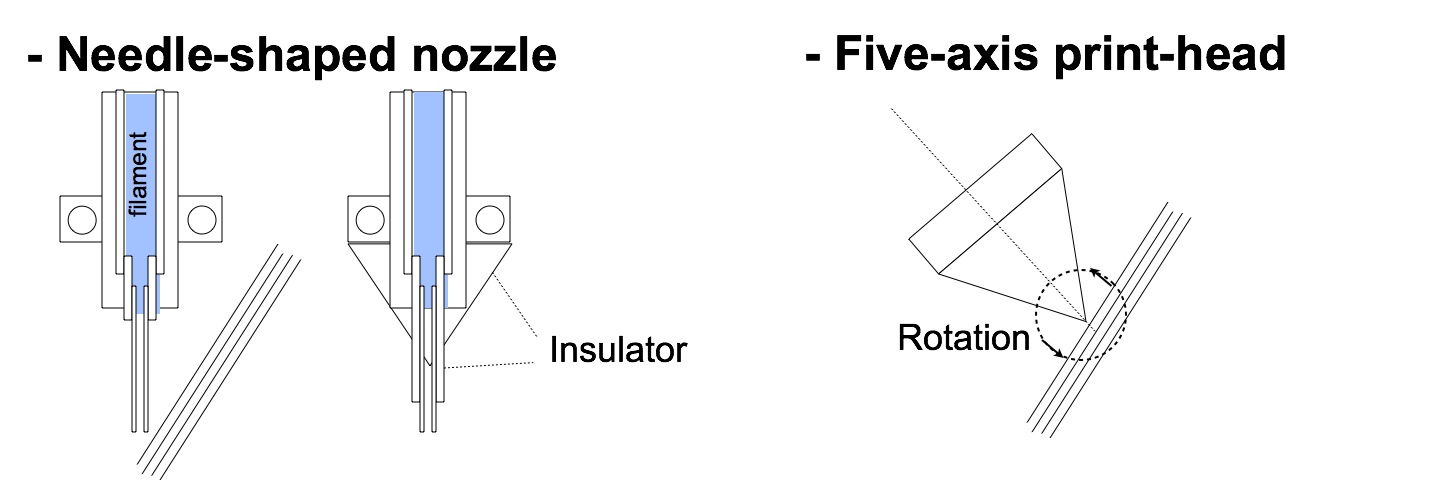
To solve the first problem, which is much more serious, two methods are available. 
One method is to use needle-shaped nozzle. 
The left half of Figure 11 shows this method. 
If the tip of a nozzle has needle-like shape, it can print in steep angle. 
However, such as shape of nozzle causes significant decrease of temperature at the tip. 
Several methods are available to keep the temperature. 
A method is to cover the tip by insulator as shown in the figure. 
A needle-shaped nozzle can print in steep angle, but it is difficult for this type of printer to print vertically. 
However, a printer of this type can be developed by improving a conventional printer. 
</p>
<p>
The other method is to use a five-axis print-head. Two additional axes are used for rotating the head. 
By rotating a print head, it can print vertically or even at downside. 
However, a printer of this type must be developed mostly from scratch. 
Xuan Song et al. [1] developed this type of 3D printer, but the rotation angle is restricted. 
</p>
<p>
<img alt="fig11.jpg" src="/research-topics-e/fig11.jpg" width="719" height="242" />
<br />
Figure 11. Two solutions to the problem in steep printing
</p>

<p>
For the solution to the second problem, see Section 6.3. 
</p>

<h3><big>6. Implementation Status</big></h3>

<p>
The implementations of natural-direction 3D printing technologies is in very early stages. 
</p>

<h4><big>6.1 Field-oriented modeling</big></h4>

<p>
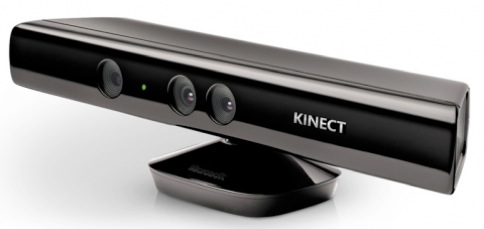
A Kinect-based modeler, which is proposed in Section 3.2, is  being designed but not yet implemented. 
</p>
<p>
<img alt="fig12.jpg" src="/research-topics-e/fig12.jpg" width="242" height="120" />
<br />
Figure 12. Microsoft Kinect
</p>

<h4><big>6.2 Field-based hashing</big></h4>

<p>
Only parts of hashing algorithms are being tested. 
As described in the previous sections, the left photo in the Figure 13 shows testing improvement of printability. The middle photo shows splitting and merging. The right photo shows another test 
print for 3D calligraphy, which will be explained in the applications section. 

</p>
<p>
<img alt="fig13.jpg" src="/research-topics-e/fig13.jpg" width="765" height="139" />
<br />
Figure 13. Hashing algorithms tested
</p>

<h4><big>6.3 Non-horizontal 3D printing</big></h4>

<p>
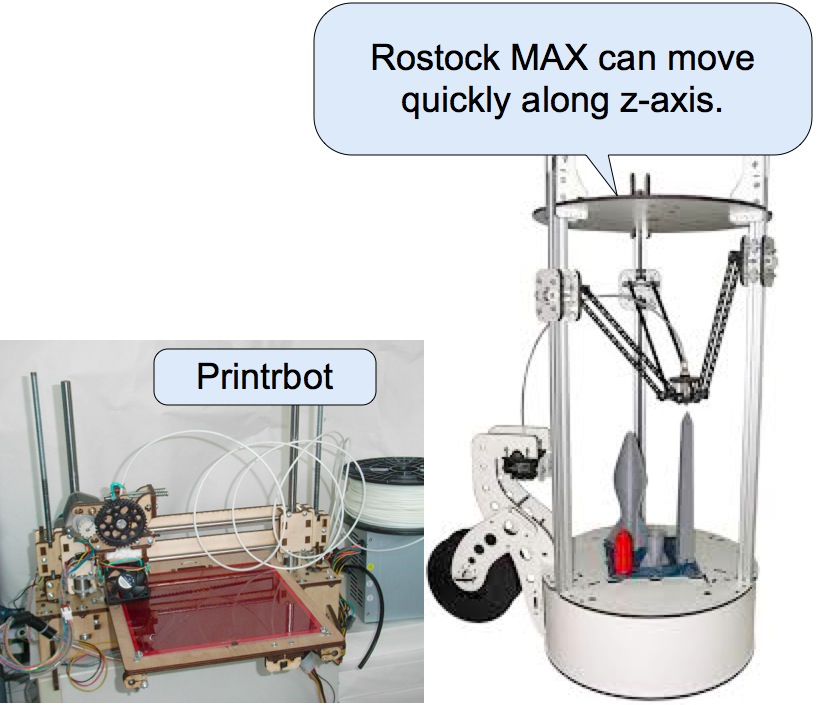
Non-horizontal printing methods has been tested using Printrbot Plus, and are  being tested 
using  Rostock MAX (see Figure 14). 
Rostock MAX is a Delta type 3D printer that can move its print head quickly along z-axis. 
Therefore, this type of printers can solve the second problem described in Section 5.1. 
</p>
<p>
<img alt="fig14.jpg" src="/research-topics-e/fig14.jpg" width="416" height="353" />
<br />
Figure 14. 3D printers used for testing the printing method and techniques
</p>

<h3><big>7. Applications</big></h3>

<p>
3D printing has been used for industrial applications, especially for rapid prototyping. 
However, major applications of natural-printing technologies may be different types of applications. 
</p>

<h4><big>7.1 Art: 3D calligraphy</big></h4>

<p>
Natural direction may be more important in artistic applications. 
This subsection focuses on applications to 3D calligraphy. 
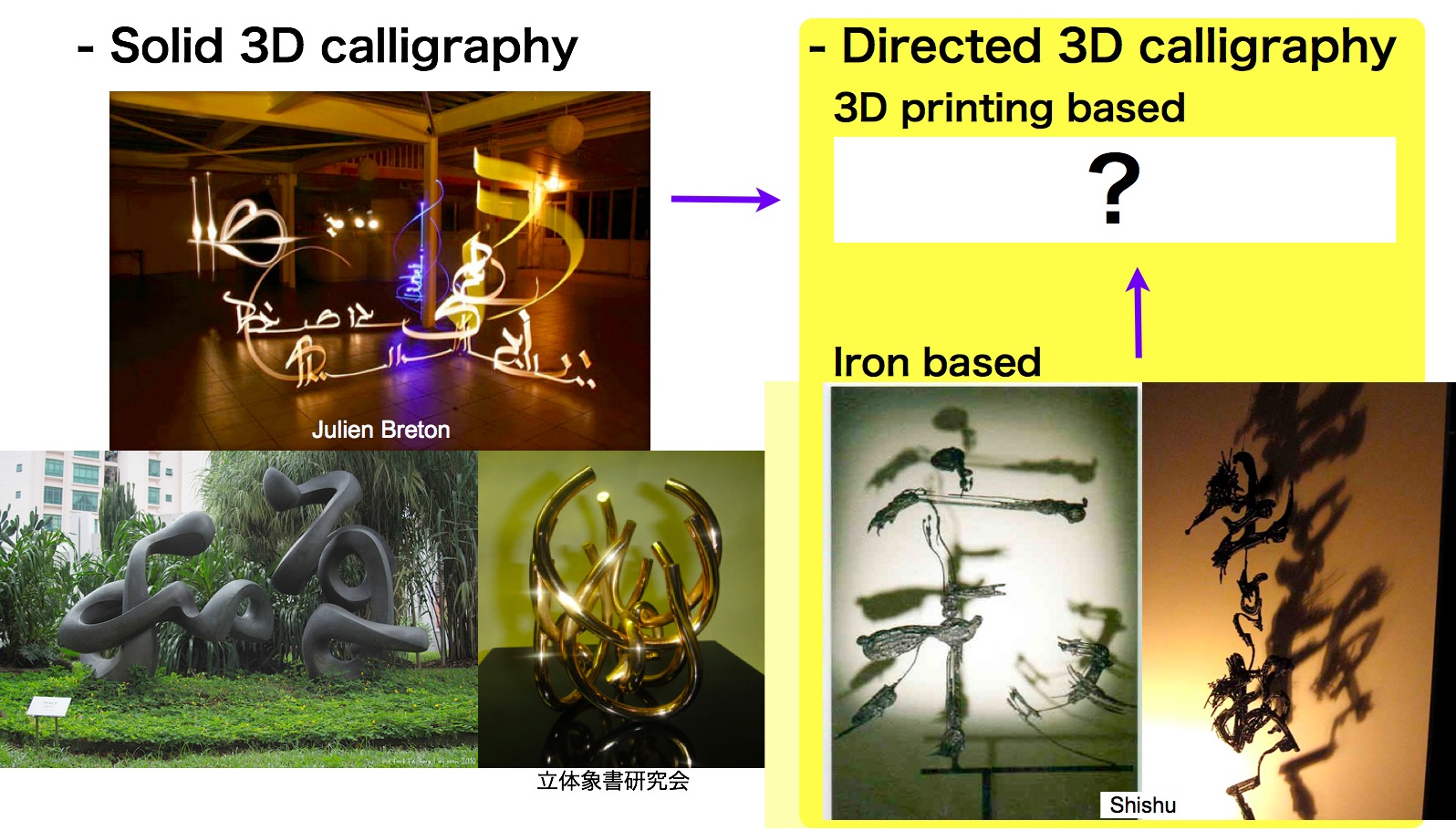
The left half of figure 15 shows (mostly) non-directed 3D calligraphy arts. 
The right half shows directed 3D calligraphy arts. 
Natural-direction printing can be applied to directed 3D calligraphy, but it has not yet applied. 
There are some work in iron based directed 3D calligraphy. 
This figure shows work of Shishu, a Japanese calligraphy artist.
</p>

<p>
<img alt="fig15.jpg" src="/research-topics-e/fig15.jpg" width="798" height="456" />
<br />
Figure 15. 3D calligraphy application
</p>

<h4><big>7.2 Hobby</big></h4>

<p>
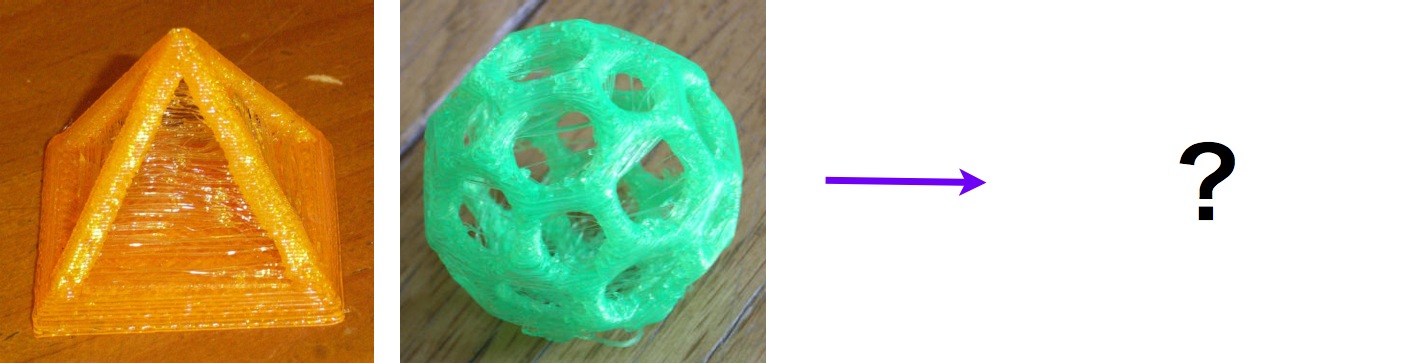
Recently, a cheap FDM 3D printers are used by hobbyists. 
A pyramid or a polyhedron shown in Figure 16 may be printed better by using natural-direction 
printing methods. 
</p>

<p>
<img alt="fig16.jpg" src="/research-topics-e/fig16.jpg" width="709" height="182" />
<br />
Figure 16. Hobby application 
</p>

<h4><big>7.3 Industrial applications</big></h4>

<p>
There may be industrial applications (see Figure 17), but promising applications are not known. 

</p>
<p>
<img alt="fig17.jpg" src="/research-topics-e/fig17.jpg" width="731" height="167" />
<br />
Figure 17. Industrial applications?
</p>

<h3><big>8. Concluding Remarks</big></h3>

<p>
This presentation can be summarized as follows.
</p>
<ul>
<li>Natural direction of 3D objects can be expressed by FDM 3D printing using field-oriented/based modeling, hashing, and printing methods.
</li>
<li>The developments of field-oriented/based algorithms and applications are in early stages.
</li>
</ul>
<p>
The field-oriented modeling, the field-based tool-path generation methods, and non-horizontal 3D 
printing methods are going to be developed, and they are applied to the applications, especially to 
3D calligraphy at first. 
</p>

<h3><big>References</big></h3>

<p>
[1] Xuan	Song, Yayue Pan,	 and Yong Chen,  “Development of a Low-Cost Parallel Kinematic Machine for Multi-Direction Additive Manufacturing”, SFF Symposium 2013.
</p>]]>
   </content>
</entry>
<entry>
   <title>Computation with randomized order</title>
   <link rel="alternate" type="text/html" href="https://www.kanadas.com/research-topics-e/2007/03/computation_with_randomized_or.html" />
   <id>tag:www.kanadas.com,2007:/research-topics-e//10.702</id>
   
   <published>2007-03-31T00:00:57Z</published>
   <updated>2007-04-15T12:30:32Z</updated>
   
   <summary> Recently, computation methods with rand...</summary>
   <author>
      <name></name>
      
   </author>
   
   <category term="131" label="CCM" scheme="http://www.sixapart.com/ns/types#tag" />
   <category term="408" label="Cellular automaton" scheme="http://www.sixapart.com/ns/types#tag" />
   
   <content type="html" xml:lang="en" xml:base="https://www.kanadas.com/research-topics-e/">
      <![CDATA[<p>
Recently, computation methods with randomness are widely studied.  
Evolutionary computation including genetic algorithms and genetic 
programming are examples of such methods. 
Computation using simulated annealing, such as Bolzmann Machine, and  
methods for increasing efficiency using randomization in classical 
algorithms are also studied. 
The randomized computation models I previous studied, i.e.,  
<a href="/research-themes-e/0000/01/ccm_chemical_casting_model.html">Chemical Computation Model (CCM)</a> and 
<a href="/research-themes-e/0000/01/raca_randomized_asynchronous_c.html">randomized 
cellular automata (RACA)</a>, also used randomized computation.
</p>
]]>
      <![CDATA[<p>
In these computation models, computation proceeds by successively applying given rules. 
The order of rule applications is randomized.
Some interesting phenomena occur by regularly (synchronously) 
applying rules, but regular application often causes unexpected 
results.  Randomness sometimes causes improvement of efficiency. 
However, I researched the computation methods above rather because, 
firstly I expected that we might be able to get intended results more easily 
without using specialized techniques, and secondly I believed 
that randomness is the source of emergence.
</p>

Pages on related researches: 
<ul>
<li><a href="http://www.smapip.is.tohoku.ac.jp/~smapip/2005/NHC+SMAPIP/index-e.html">
Randomness and Computation (RC2005)</a></li>
</ul>
]]>
   </content>
</entry>
<entry>
   <title>Software and hardware</title>
   <link rel="alternate" type="text/html" href="https://www.kanadas.com/research-topics-e/2006/10/software_and_hardware.html" />
   <id>tag:www.kanadas.com,2006:/research-topics-e//10.279</id>
   
   <published>2006-10-18T13:01:46Z</published>
   <updated>2007-03-24T07:44:38Z</updated>
   
   <summary> This entry focuses on my hobby rather t...</summary>
   <author>
      <name></name>
      
   </author>
   
   <category term="352" label="Hobby" scheme="http://www.sixapart.com/ns/types#tag" />
   <category term="160" label="Programming language" scheme="http://www.sixapart.com/ns/types#tag" />
   
   <content type="html" xml:lang="en" xml:base="https://www.kanadas.com/research-topics-e/">
      <![CDATA[<p>
This entry focuses on my hobby rather than research.
</p>

To be described.  
]]>
      <![CDATA[<p>
このエントリーは研究というよりは趣味のはなしが中心です．
</p>

<p>
大学 2 年になるまで，私にはソフトウェアというものにはほとんど縁がありませんでした． 
一方で小学生のころからハードウェアには興味があり，ラジオやその他の電子工作をしていました． 
中学・高校のころにはオーディオファンになって，いまもある 「無線と実験」，「ラジオ技術」 などの雑誌をみて，ステレオアンプをつくりました． 
そういう私にとって，秋葉原で <a href="http://ja.wikipedia.org/wiki/Intel_8080">Intel 8080</a> が売られるようになると，それをつかって
マイクロコンピュータをつくるというのは，むしろ自然なことでした． 
このマイコン製作については<a href="/weblog/2006/10/9080.html">ブログのエントリー</a>に書いています． ここにも書いているように，デジタル回路の実装をよく
しらなかったために，おそろしく複雑な配線をすることになり，もうハードウェアは
やめようとおもうにいたりました． そしてソフトウェアの世界にはいってきたわけです．
</p>
<p>
就職してまもなく，ベクトル型のスーパーコンピュータ <a href="http://www.ipsj.or.jp/katsudou/museum/computer/2040_e.html">S-810</a> のコンパイラの仕事にたずさわりました． 
コンパイラはハードウェアとソフトウェアとの境界のプログラムであり，またとくに
あたらしく開発されたコンピュータのためのコンパイラなので，
ハードウェアをつよく意識しました． 当時の汎用コンピュータのコンパイラ開発に
おいてはハードウェアの特性をそれほど意識しなかったのではないかと
おもうのですが 
(いまでは RISC のためのコンパイラ開発ではハードウェアをつよく意識するのは当然のことだとおもいますが)，
スーパーコンピュータはハードウェアをうまくつかうかどうかで
性能がおおきくかわってくるため，ハードウェアの設計者からもしばしば話を
きいていました． 
</p>
<p>
コンパイラ屋をやめてからはハードウェアを意識することもすくなくなりましたが，
DOS/V パソコンの部品が秋葉原で売られるようになってからは，ふたたび
自分でパソコンをくみたてています． 自宅でつかう DOS/V パソコンは，
家族のものもふくめて，すべて私がくみたてたものです． 
自宅でやるひとはたくさんいますが，私は会社でつかっているパソコンも
たいてい，くみたてています． 会社ではなかなか道具がそろわないので，
机のなかにドライバーやラジオペンチをもっています． 
しかし，単なるくみたて以上のことは，ひさしくやっていません． 
近年は FPGA がひろくつかわれるようになって，半田ごてなしでハードウェアを
開発することができるようになっているので，やってみたいとはおもっていますが，
いまのところ，なかなか手がだせないでいます． 
もう，いい年になっているので，定年後のたのしみとしてとっておくということに
なるかもしれません．
</p>
]]>
   </content>
</entry>
<entry>
   <title>Fusion of digital and analog</title>
   <link rel="alternate" type="text/html" href="https://www.kanadas.com/research-topics-e/2006/10/fusion_of_digital_and_analog.html" />
   <id>tag:www.kanadas.com,2006:/research-topics-e//10.278</id>
   
   <published>2006-10-18T12:58:28Z</published>
   <updated>2007-03-31T05:24:41Z</updated>
   
   <summary> One of my research focus that is common...</summary>
   <author>
      <name></name>
      
   </author>
   
   <category term="109" label="Axis-specified search" scheme="http://www.sixapart.com/ns/types#tag" />
   <category term="131" label="CCM" scheme="http://www.sixapart.com/ns/types#tag" />
   <category term="4" label="voiscape" scheme="http://www.sixapart.com/ns/types#tag" />
   
   <content type="html" xml:lang="en" xml:base="https://www.kanadas.com/research-topics-e/">
      <![CDATA[<p>
One of my research focus that is common to my several research themes is, in short, "fusion of digital and analog".  
There was so-called 
<a href="http://en.wikipedia.org/wiki/Analog_computer">analog computer</a>, 
but now it has become 
old fashioned.  Nowadays, the word "computer" certainly means a digital computer.  
However, human senses are inherently analog, so I think computers should come close to analog senses for the sake of ease of use. 
It means that combination or fusion of good points of digital and analog is required.  
Although analog computers were dead, 
<a href="http://en.wikipedia.org/wiki/Neural_network">neural networks</a> that replaced 
analog computers (?!) had some good points of analog things.  
Since I was stimulated by them, I thought of fusion of digital and analog 
very frequently.  
</p>
]]>
      <![CDATA[<p>
In the research of 
<a href="/research-themes-e/0000/01/ccm_chemical_casting_model.html">CCM 
(Chemical Computation Model)</a>, 
I studied computation using production rules called reaction rules and 
evaluation functions called local order degrees.  
Here, reaction rules are digital, and local order degrees are analog.  
We can solve many problems, constraint satisfaction and optimization problems, 
using the combination of these two.  
In digital worlds, programs often do not stop at appropriate point but run away if writing a wrong program.  
However, combination with certain analog thing, i.e., 
using a function with a minimal value, probably makes the chance of such 
happenings less.  
</p>
<p>
In 
<a href="/research-themes-e/0000/01/axisspecified_search_thematic.html">axis-specified search</a>, 
by specifying "search axis" in addition to search keywords, 
we can get search results that are well-organized along the axis. 
Here, a keyword search is digital, but it is combined with "axis", 
which is analog.  
For example, if we specify time as axis, we can get results 
sorted by time, i.e., we can get a chronological table.
Or, if we specify geographical space as axis, we can get 
results on a map. 
</p>
<p>
If we use 
<a href="/research-themes-e/0000/01/voiscape_a_virtual_sound_room_1.html">voiscape  
(a virtual "sound room" based communication medium)</a>, 
two or more people can talk in a virtual sound space enabled by 
spatial audio technology.  
The objective of this research is to enable more natural human conversation 
through a medium by expressing feeling of direction and distance 
of voices by using spatial audio.  
In conventional media, such as telephone, the communication state 
was one of two digital states, i.e., connected to or disconnected from 
the other party.  
In voiscape, the other party can be in any distance and in any direction, i.e., it realizes 
analog states.  
</p>
]]>
   </content>
</entry>
<entry>
   <title>The N queens problem</title>
   <link rel="alternate" type="text/html" href="https://www.kanadas.com/research-topics-e/2006/10/the_n_queens_problem.html" />
   <id>tag:www.kanadas.com,2006:/research-topics-e//10.277</id>
   
   <published>2006-10-18T12:31:44Z</published>
   <updated>2008-03-23T02:28:05Z</updated>
   
   <summary><![CDATA[   &nbsp;   &nbsp;   &nbsp;Q&nbsp;   &nb...]]></summary>
   <author>
      <name></name>
      
   </author>
   
   <category term="131" label="CCM" scheme="http://www.sixapart.com/ns/types#tag" />
   <category term="235" label="vectorization of symbol-processing" scheme="http://www.sixapart.com/ns/types#tag" />
   
   <content type="html" xml:lang="en" xml:base="https://www.kanadas.com/research-topics-e/">
      <![CDATA[<table border="0" align="right" bgcolor="gray">
<tr align="center">
  <td bgcolor="#FFFF99">&nbsp;</td>
  <td bgcolor="#C0C0FF">&nbsp;</td>
  <td bgcolor="#FFFF99">&nbsp;Q&nbsp;</td>
  <td bgcolor="#C0C0FF">&nbsp;</td>
</tr>
<tr align="center">
  <td bgcolor="#C0C0FF">&nbsp;Q&nbsp;</td>
  <td bgcolor="#FFFF99">&nbsp;</td>
  <td bgcolor="#C0C0FF">&nbsp;</td>
  <td bgcolor="#FFFF99">&nbsp;</td>
</tr>
<tr align="center">
  <td bgcolor="#FFFF99">&nbsp;</td>
  <td bgcolor="#C0C0FF">&nbsp;</td>
  <td bgcolor="#FFFF99">&nbsp;</td>
  <td bgcolor="#C0C0FF">&nbsp;Q&nbsp;</td>
</tr>
<tr align="center">
  <td bgcolor="#C0C0FF">&nbsp;</td>
  <td bgcolor="#FFFF99">&nbsp;Q&nbsp;</td>
  <td bgcolor="#C0C0FF">&nbsp;</td>
  <td bgcolor="#FFFF99">&nbsp;</td>
</tr>
</table>
<p>
It is time consuming to solve the <i>N</i> queens problem (See the description below), as same as other constraint-satisfaction problems.  
Therefore, many methods are deviced to solve it faster.  
In my research, I often used this problem as an example too.
</p>
]]>
      <![CDATA[<p>
The first time I used this in <a href="/research-themes-e/0000/01/logicsymbolic_vector_processin.html">Logic/Symbolic Vector Processing</a>.  
By using a logic programming language such as Prolog, you can program 
exaustive search using 
<a href="http://en.wikipedia.org/wiki/Backtracking">backtracking</a>.  The objective of this research was to 
convert such programs to high-speed programs for supercomputers.  
However, the acceleration ratio of even a successfully converted program 
was constant, so the program still needs exponential computation time.
</p>
<p>
The second time I used this problem 
in <a href="/research-themes-e/0000/01/ccm_chemical_casting_model.html">CCM (Chemical-Computation Model)</a>.  
In CCM, randomness was inherently introduced, and we did not aim perfect computation (or complete method).  
In such a stochastic computation, it does not need exponential computation time.  
By using CCM, you can find a solution by a personal computer much faster than by a supercomputer using a backtracking method.  
You can try such computation by using 
<a href="/ccm/queens-sort/index.html">the <i>N</i> Queens Problem and Sorting</a> page, which contains CCM-based Java program of the <i>N</i> queens problem.  
You can try various methods by changing options on this page, 
but I will describe the detail of this issue in another opportunity. 
(But the above page contains most of such information.)  
To develop stochastic solving methods, neural networks and 
genetic algorithms can also be used.  The method using CCM 
has similar nature to such methods.  
</p>
<p>
Apart from Kanada's research, the <i>N</i> queens problem is also used 
in N. Wirth's book titled "Algorithms and Data Structures".&nbsp;  
R. W. Floyd's paper titled "Nondeterministic Algorithms" 
(Journal of the ACM, Vol. 14, No. 4 (1967), pp. 636-644)
also used this problem.  This paper was 
<a href="http://fw8.bookpark.ne.jp/cm/ipsj/search_test.asp?flag=6&keyword=IPSJ-MGN440215&mode=PRT">explained</a>  by Kanada in the 2003-February issue of "Information Processing"  (Vol. 44, No. 2, p. 198).  
As I wrote in this explanation, the problem was also used as 
an example of quantum computation.  
</p>

<p><a name="n-queens">Explanation of the <i>N</i> queens problem</a></p>
<p>
The eight queens problem is the problem to get layouts of eight queens on a chess board without taking each other.  
An extension of this problem to <i>N</i>-by-<i>N</i> board is the 
<i>N</i> queens problem.  
Problems to get a solution that satisfies given conditions, such as 
the <i>N</i> queens problem, are called 
<a href="http://en.wikipedia.org/wiki/Constraint_satisfaction">constraint satisfaction</a> 
problems (CSPs).  Many CSPs belongs to a class of difficult problems, 
called NP (Non-Polynomical), which can only be solved by enumerating solutions.  
The <i>N</i> queens problem is one of them.  
The reason why this class is called non-polynomial is that 
problems in this class cannot be solved in time represented by 
<i>N</i>'s polynomial expression (i.e., it takes exponential time 
to solve them).  
</p>
<p>
[Related page: <a href="/puzzles/queens.html">The <i>N</i> Queens Page</a>]
</p>

]]>
   </content>
</entry>
<entry>
   <title>Purpose of this blog</title>
   <link rel="alternate" type="text/html" href="https://www.kanadas.com/research-topics-e/2006/10/purpose_of_this_blog.html" />
   <id>tag:www.kanadas.com,2006:/research-topics-e//10.271</id>
   
   <published>2006-10-16T14:09:02Z</published>
   <updated>2007-03-24T07:56:12Z</updated>
   
   <summary>When I became a research scientist, I de...</summary>
   <author>
      <name></name>
      
   </author>
   
   
   <content type="html" xml:lang="en" xml:base="https://www.kanadas.com/research-topics-e/">
      <![CDATA[When I became a research scientist, I decided my research themes according to 
my preference.  However, I moved again and again to various research areas according to the 
needs of my company and societies.  Those themes do not seem to be related each other at a glance.  
However, there are common backgrounds or philosophies among them.  
In this blog, I will write such a relatively heavy topics that spread among two or more research themes.  
Initially, I intended to write such issues in 
<a href="/weblog-e/">my general blog</a>, but I changed my mind to separate them.  
Relatively light topics on one research theme are described in 
the general blog.  
I also made <a href="/research-topics-j/">a Japanese version of 
this blog</a>.

By the way, the research themes in my company are described, but I write them as a research scientist and my company has no concern to these descriptions.  

]]>
      
   </content>
</entry>
<entry>
   <title>My lifework</title>
   <link rel="alternate" type="text/html" href="https://www.kanadas.com/research-topics-e/2005/02/my_lifework.html" />
   <id>tag:www.kanadas.com,2005:/research-topics-e//10.473</id>
   
   <published>2005-02-02T15:00:00Z</published>
   <updated>2007-03-31T10:03:33Z</updated>
   
   <summary> I have studied  CCM (Chemical Computati...</summary>
   <author>
      <name></name>
      
   </author>
   
   <category term="109" label="Axis-specified search" scheme="http://www.sixapart.com/ns/types#tag" />
   <category term="131" label="CCM" scheme="http://www.sixapart.com/ns/types#tag" />
   <category term="4" label="voiscape" scheme="http://www.sixapart.com/ns/types#tag" />
   
   <content type="html" xml:lang="en" xml:base="https://www.kanadas.com/research-topics-e/">
      <![CDATA[<p>
I have studied 
<a href="/research-themes-e/0000/01/ccm_chemical_casting_model.html">CCM (Chemical Computation Model)</a> for emergent computation, 
<a href="/research-themes-e/0000/01/axisspecified_search_thematic.html">axis-specified search</a>, 
<a href="/research-themes-e/0000/01/voiscape_a_virtual_sound_room_1.html">voiscape</a> (a virtual "sound room" based communication medium), and so on.  
There are common "themes" among the above three researches.  
They are 
<a href="/research-topics-e/2006/10/fusion_of_digital_and_analog.html">"fusion of digital and analog"</a> and 
"fusion of symbols and subsymbols".  
</p>
]]>
      <![CDATA[<p>
CCM is a computation model that leads symbolic or "digital" computations represented by 
motions in discrete state spaces to a solution by using so-called local order 
degrees (a type of evaluation functions), which are "analog".  
</p>
<p>
Axis-specified search is a method of search, which organizes the 
results of "digital" keyword searches by using time --a one-dimensional "analog" quantity -- (in the case of year-axis search) or by using area or map -- a two-dimensional "analog" quantity -- (in the case of geographical axis search). 
I tried to enable intuitive grasp of search results by putting them 
in analog spaces.  
</p>
<p>
In voiscape, voice itself has both digital nature called language  
and analog nature called sound, but, in addition, by putting it 
in a three- (or two-) dimensional analog space, 
move it from two-valued (digital) world to a world with 
perspective, which can be well grasped by human senses.
</p>

<p>
Although the two research themes except voiscape, which is ongoing, 
cannot be called life works.  However, I believe 
the common themes, i.e., 
"fusion of digital and analog" and "fusion of symbols and subsymbols" will be my life works.  
In addition, I changed my research themes as the above order, but 
I think I can say my research theme gradually becomes closer to 
"human beings". 
In my master's thesis, I chose 
<a href="/research-themes-e/0000/01/programming_linguistics.html">"programming linguistics"</a> as the 
research theme.  Since then, except CCM, I can say I tried to 
revive human existence where it was conventionally ignored or abstract away.  
</p>
<p>Note: Because I included a content in an independent Web page 
into this blog, the submission date is before the date I started 
this blog.
</p>
]]>
   </content>
</entry>

</feed>