<?xml version="1.0" encoding="UTF-8"?>
<feed xmlns="http://www.w3.org/2005/Atom">
   <title>Kanada&apos;s Research Themes</title>
   <link rel="alternate" type="text/html" href="http://www.kanadas.com/research-themes-e/" />
   <link rel="self" type="application/atom+xml" href="http://www.kanadas.com/research-themes-e/atom.xml" />
   <id>tag:www.kanadas.com,2008:/research-themes-e//8</id>
   <updated>2007-05-08T13:20:41Z</updated>
   <subtitle><![CDATA[This is a summary of themes that I have researched in my company, universities, etc.  The research themes in my company are described, but I write them as a research scientist and my company has no concern to these descriptions. 
If you do not want to publish your comment, send it to yasusi&nbsp;@&nbsp;kanadas.com
]]></subtitle>
   <generator uri="http://www.sixapart.com/movabletype/">Movable Type 3.36</generator>

<entry>
   <title>voiscape: a virtual &quot;sound room&quot; based communication medium</title>
   <link rel="alternate" type="text/html" href="http://www.kanadas.com/research-themes-e/0000/01/voiscape_a_virtual_sound_room_1.html" />
   <id>tag:www.kanadas.com,0000:/research-themes-e//8.244</id>
   
   <published>2000-01-08T15:00:00Z</published>
   <updated>2007-05-08T13:20:41Z</updated>
   
   <summary>Development of a new communication medium by which two or more persons can talk each other by 
using a virtual sound space based on spatial sound technology.  </summary>
   <author>
      <name></name>
      
   </author>
   
   <category term="4" label="voiscape" scheme="http://www.sixapart.com/ns/types#tag" />
   
   <content type="html" xml:lang="en" xml:base="http://www.kanadas.com/research-themes-e/">
      <![CDATA[<h3><a name="voiscape">What is voiscape?</a></h3>

<p>
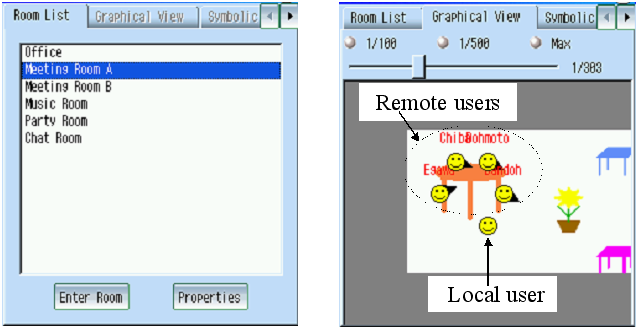
The purpose of this research is to develop a new voice-communication medium called <em>voiscape</em>.  By this medium, two or more persons can talk each other by 
using a virtual sound space based on spatial sound technology.  People can move freely in the "sound room" and people can choose, enter, and exit from a room.  Cocktail-party like situation can be created with this medium.  In short, this project targets realizing Second-Life-like world by sound.
</p>
]]>
      <![CDATA[<h3><a name="voiscape-doc">Papers on voiscape</a></h3>

<p>
Papers on voiscape are available 
<a href="/papers-e/communication_and_networking/">here</a>.
</p>

<h3><a name="articles">Magazine articles etc. on voiscape</a></h3>

<ul>
<li>
<a href="http://techon.nikkeibp.co.jp/article/HONSHI/20061108/123257/">Tech Analysis: Recapturing Original Sound</a>, 
<a href="http://techon.nikkeibp.co.jp/article/HONSHI/20061026/122728/">Nikkei Electronics Asia - May 2006</a>.
</li>
<li><a href="http://cache.zoominfo.com/cachedpage/?archive_id=0&page_id=1563136563&page_url=%2f%2fwww.monitor4u.com%2fenglish%2fnews%2fcont.asp%3fidx%3d1285%26contdiv%3d&page_last_updated=5%2f28%2f2006+3%3a15%3a19+AM&firstName=Yasushi&lastName=Kanada">Recapturing Original Sound</a>, Games, Business: Hitachi Ltd of Japan, meanwhile, is exploring business use. Yasushi Kanada, senior researcher, ...
</li>
</ul>

<img alt="O" src="../../../research-themes-j/voiscape.png" />]]>
   </content>
</entry>
<entry>
   <title>Policy-based Networking and QoS Guarantee</title>
   <link rel="alternate" type="text/html" href="http://www.kanadas.com/research-themes-e/0000/01/policybased_networking_and_qos.html" />
   <id>tag:www.kanadas.com,0000:/research-themes-e//8.246</id>
   
   <published>2000-01-07T15:00:00Z</published>
   <updated>2007-04-06T15:54:12Z</updated>
   
   <summary>Research on methods of combining (composing) policies, or on component-based policies. </summary>
   <author>
      <name></name>
      
   </author>
   
   <category term="206" label="Policy-based networking" scheme="http://www.sixapart.com/ns/types#tag" />
   <category term="22" label="QoS" scheme="http://www.sixapart.com/ns/types#tag" />
   
   <content type="html" xml:lang="en" xml:base="http://www.kanadas.com/research-themes-e/">
      <![CDATA[<h3><a name="policy-qos">What is this research?</a></h3>

<p>
Complex computer and communication systems require complex policies.  I studied methods of combining (composing) policies, or I studied component-based policies.  I have also studied methods of (policy-based) <a href="http://en.wikipedia.org/wiki/QoS">QoS</a> guarantee (especially, <a href="http://en.wikipedia.org/wiki/Diffserv">Diffserv</a>) 
on IP networks.
</p>
]]>
      <![CDATA[<h3><a name"policy-qos-doc">Papers on networking and QoS</a></h3>

<p>
Papers are available <a href="/papers-e/communication_and_networking/">here</a>.
</p>

<h3><a name"ANPB-page">Active Networks, Policy-based Networking and QoS Assurance</a></h3>

<p>
<a href="/activenet/index.html">This page</a> explaines active networks and the relationships between the above three issues.
</p>
]]>
   </content>
</entry>
<entry>
   <title>Axis-Specified Search (Thematic Search)</title>
   <link rel="alternate" type="text/html" href="http://www.kanadas.com/research-themes-e/0000/01/axisspecified_search_thematic.html" />
   <id>tag:www.kanadas.com,0000:/research-themes-e//8.247</id>
   
   <published>2000-01-06T15:00:00Z</published>
   <updated>2007-03-28T14:13:30Z</updated>
   
   <summary>Development of search methods in which users (searchers) specify an axis of search in addition to keywords and in which the search results are arranged along the axis.  </summary>
   <author>
      <name></name>
      
   </author>
   
   <category term="109" label="Axis-specified search" scheme="http://www.sixapart.com/ns/types#tag" />
   
   <content type="html" xml:lang="en" xml:base="http://www.kanadas.com/research-themes-e/">
      <![CDATA[<h3><a name="axis-overview">What is axis-specified search?</a></h3>

<p>
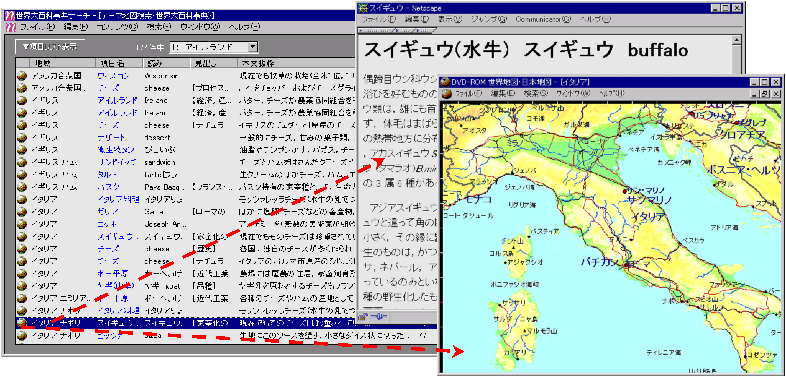
The axis-specified search is a method of text search, especially for encyclopedia search.  Users (searchers) specify an axis of search in addition to keywords.  The search results are arranged along the axis.  For example, if the axis is "year", the result is a chronological table.  The axis can also be "geography" or various types of "quantity".
</p>
]]>
      <![CDATA[<h3><a name="axis-doc">Papers on axis-specified search</a></h3>

<p>
The most important paper on this research is
<a href="/papers-e/1998/06/axisspecified_search_a_finegra.html">"Axis-specified Search: A Fine-grained Full-text Search Method for Gathering and Structuring Excerpts"</a>. 
The method of extracting geographical names is described in 
<a href="/papers-e/1999/11/kanada_y_a_method_of_geographi.html">"A Method of Geographical Name Extraction from Japanese Text for Thematic Geographical Search"</a>.  
Other papers are available <a href="/papers-e/search_extraction_and_organiza/">here</a>.
</p>

<h3><a name="thematic-search-page">Thematic Search (Axis-specified Search) Page</a></h3>

<p>
<a href="/search/axis.html">This page</a> contains information on "Net-de-hyakka" etc.
</p>

<img alt="O" src="../../../research-themes-j/thematic_search.png" />
]]>
   </content>
</entry>
<entry>
   <title>Self-reproduction of Web pages</title>
   <link rel="alternate" type="text/html" href="http://www.kanadas.com/research-themes-e/0000/01/selfreproduction_of_web_pages.html" />
   <id>tag:www.kanadas.com,0000:/research-themes-e//8.259</id>
   
   <published>2000-01-06T03:00:00Z</published>
   <updated>2007-05-07T16:27:58Z</updated>
   
   <summary>Small-scale research on developing a method for reproducing and displaying exactly or almost the same Web page as the original.</summary>
   <author>
      <name></name>
      
   </author>
   
   <category term="160" label="Programming language" scheme="http://www.sixapart.com/ns/types#tag" />
   
   <content type="html" xml:lang="en" xml:base="http://www.kanadas.com/research-themes-e/">
      <![CDATA[<h3><a name="reproduction">What is this?</a></h3>

<p>
This is a small-scale research on developing a method for reproducing and displaying exactly or almost the same Web page as the original (i.e., complete or incomplete reproduction).
</p>
]]>
      <![CDATA[<h3><a name="reproduction-doc">Papers and demo</a></h3>

<ul>
<li><a href="/reproduction/index.html">Web pages for trying self-reproduction by yourself</a> 
(You need Netscape Navigator 4.0 to test part of these pages.)
</li>
<li><a href="/papers-e/1997/11/web_pages_that_reproduce_thems.html">An English paper</a> and 
<a href="/papers-e/1997/07/web_pages_that_reproduce_thems_1.html">a Japanese paper</a>
</li>
</ul>
]]>
   </content>
</entry>
<entry>
   <title>CCM: Chemical-Computation Model</title>
   <link rel="alternate" type="text/html" href="http://www.kanadas.com/research-themes-e/0000/01/ccm_chemical_casting_model.html" />
   <id>tag:www.kanadas.com,2006:/research-themes-e//8.237</id>
   
   <published>2000-01-04T15:00:00Z</published>
   <updated>2007-03-28T14:14:10Z</updated>
   
   <summary>Research on a computation method in which only local information is used, i.e., each action in CCM refers only a few data, and there is no global plan (i..e., no program) for the computation.</summary>
   <author>
      <name></name>
      
   </author>
   
   <category term="131" label="CCM" scheme="http://www.sixapart.com/ns/types#tag" />
   
   <content type="html" xml:lang="en" xml:base="http://www.kanadas.com/research-themes-e/">
      <![CDATA[<IMG ALT="O" ALIGN="left" SRC="/Papers/CCM-logo.gif">
<h3><A NAME="what-is-CCM">What is CCM?</A></h3>

<p>
CCM (Chemical Casting Model, or Chemical-Computation Model) is a model for <em>emergent computation</em>.
CCM works <em>only with local information</em>, i.e., each reaction (unit action)
in CCM refers only a few data, and there is <em>no global plan</em> (i..e., no program) for the computation.
CCM is based on a production system (a type of rule-based computation method), which is similar to chemical
reaction systems (rather than conventional production systems used for
developing expert systems).  Two features of CCM are as follows.
</p>

<ul>
<li>CCM works with locally-defined evaluation functions,
    which is called <em>local order degrees</em>.
</li>
<li>The order of reactions (rule applications) is
    random (or, stochastic or non-deterministic).
    Randomness is a source of emergence.
</li>
</ul>
<p>
In addition, <em>catalysts</em> do not change by reactions but affects the reaction velocity, a type of tunneling effect is caused by reaction rule composition, and annealing-like effects are caused by <em>Frustration Accumulation Method</em> (FAM).
</p>
]]>
      <![CDATA[<h3><A NAME="CCM-documents">CCM-related Documents</A></h3>

<ul>
<li><A HREF="/papers-e/emergent_computation_and_combi/">
    List of PDF or postscript papers</A>
</li>
<li><a href="/ccm/examples.html">Demos on CCM</a> (The <i>N</i> queens, map coloring, and magic square problems are available.)
    <IMG ALT="*" SRC="/gif/smiley.gif">
</li>
<li><A HREF="/CCM/report94.html">A Report on Recent Research Results</A>
</li>
<li><A HREF="/CCM/index.html">CCM home page</A>,
    including a list of recent papers and several papers in HTML (hypertext papers).
</li>
</ul>

<p>
I initially called this model "Chemical Programming Model".  However, to stress the difference from conventional programming, I renamed it CCM.  
The "C" in the center was the capital of "Casting"; I used this word to stress 
the difference from computation using a program.  However, now I think it should be 
the capital of "Computation" because it is more understandable.
</p>
]]>
   </content>
</entry>
<entry>
   <title>RACA: Randomized Asynchronous Cellular Automata</title>
   <link rel="alternate" type="text/html" href="http://www.kanadas.com/research-themes-e/0000/01/raca_randomized_asynchronous_c.html" />
   <id>tag:www.kanadas.com,2006:/research-themes-e//8.238</id>
   
   <published>2000-01-03T15:00:00Z</published>
   <updated>2007-04-15T04:56:18Z</updated>
   
   <summary>Small-scale research on asynchronous and non-deterministic (i.e., randomized) cellular automata, but an article in Wikipedia described it (in March 2007).</summary>
   <author>
      <name></name>
      
   </author>
   
   <category term="204" label="Cellular automata" scheme="http://www.sixapart.com/ns/types#tag" />
   
   <content type="html" xml:lang="en" xml:base="http://www.kanadas.com/research-themes-e/">
      <![CDATA[<IMG ALT="O" ALIGN="left" SRC="/Papers/ACA-logo.gif">
<h3><A NAME="what-is-RACA">What is RACA?</A></h3>

<p>
RACA is a model for <a href="http://en.wikipedia.org/wiki/Complex_system">complex systems</a>.  Conventional cellular automata,
which was studied by Wolfram, are synchronous and deterministic.  On the
contrary, RACA are asynchronous and non-deterministic, or more precisely,
they are randomized.  RACA and CCM are similar
in their stochastic behavior.  The research of RACA was initially started when I computed cellular automata by using CCM.
</p>
]]>
      <![CDATA[<h3><A NAME="RACA-documents">RACA-related Documents</A></h3>

<ul>
<li><A HREF="/CA/index.html">
    Kanada's cellular automata home page</A>,
    including a paper in HTML (hypertext paper).
</li>
<li><A HREF="/papers-e/emergent_computation_and_combi/index.html#RACA-poster">
    List of PDF or postscript papers</A>
</li>
</ul>

<h3><a href="note">Note</a></h3>

<p>
I spent only very limited time for this research, and it was accepted only as 
<a href="http://www.kanadas.com/papers-e/1994/07/the_effects_of_randomness_in_a.html">a poster in ALIFE IV</a>.  
In spite of these facts, I found this paper, which was not included in the ALIFE IV proceedings, has been referred to by <a href="/CA/refer.html">eleven papers</a> and the article of <a href="http://en.wikipedia.org/wiki/Asynchronous_Cellular_Automaton">Asynchronous Cellular Automaton</a> in Wikipedia (in March 2007).  It seems to be amazing for me.  
I found one of them at <a href="http://citeseer.ist.psu.edu/">Citeseer</a>.  
However, if <a href="http://scholar.google.com/">Google Scholar</a> did not 
exist, I could not find most of them.
</p>

<h3><a name="related">Related pages</h3>

<ul>
<li><a href="http://www.complexity.org.au/vlab/ca/1D/asynchronous/">VLAB (www.complexity.org.au)</a></li>
</ul>
]]>
   </content>
</entry>
<entry>
   <title>Logic/Symbolic Vector Processing</title>
   <link rel="alternate" type="text/html" href="http://www.kanadas.com/research-themes-e/0000/01/logicsymbolic_vector_processin.html" />
   <id>tag:www.kanadas.com,2006:/research-themes-e//8.239</id>
   
   <published>2000-01-03T14:00:00Z</published>
   <updated>2007-03-28T14:14:54Z</updated>
   
   <summary>Development of methods of vector processing
of logic programming languages and/or symbolic vector processing etc.</summary>
   <author>
      <name></name>
      
   </author>
   
   <category term="176" label="Vectorization of symbol processing" scheme="http://www.sixapart.com/ns/types#tag" />
   
   <content type="html" xml:lang="en" xml:base="http://www.kanadas.com/research-themes-e/">
      <![CDATA[<h3><A NAME="what-is-Pilog">What is This Research?</A></h3>

<p>
The aim of this research was to establish methods of vector processing
of logic programming languages and/or symbolic vector processing.
The main target machines were vector supercomputers, such as Cray X-MP
or Hitachi S-820.  However, this research also aimed symbolic
supercomputing on SIMD parallel processors, such as CM-1.
</p>
]]>
      <![CDATA[<h3><A NAME="Pilog-documents">Related Documents</A></h3>

<ul>
<li><A HREF="/papers-e/super_symbolcomputing/">
    List of PDF or postscript papers</A>
</li>
</ul>
]]>
   </content>
</entry>
<entry>
   <title>Programming Linguistics</title>
   <link rel="alternate" type="text/html" href="http://www.kanadas.com/research-themes-e/0000/01/programming_linguistics.html" />
   <id>tag:www.kanadas.com,2007:/research-themes-e//8.700</id>
   
   <published>2000-01-02T15:00:00Z</published>
   <updated>2008-06-09T13:54:55Z</updated>
   
   <summary>Research on programming languages (programs) using the methods of linguistics.
</summary>
   <author>
      <name></name>
      
   </author>
   
   
   <content type="html" xml:lang="en" xml:base="http://www.kanadas.com/research-themes-e/">
      <![CDATA[<h3>Research focus</h3>

<p>
I tried to apply methods of linguistics, in which human languages are treated, to analyze programs.  
I was involved in this research only a short period, i.e., while I was writing my master's thesis.  I tried to continue this research, but I got no fruits.
</p>
]]>
      <![CDATA[<h3>Related pages</h3>

<ul>
<li><a href="/weblog-e/2008/06/linguistics_of_programming_lan_1.html" target="_blank">Linguistics of programming languages ― now an inquiry on my graduate thesis came from France</a>
</li>
<li><a href="/weblog-e/2008/06/programming_linguistics_morpho_1.html" target="_blank">Programming linguistics ― Morphology since then</a>
</li>
</ul>

<h3>Paper</h3>

<ul>
<li><a href="/papers-e/1981/03/toward_programming_linguistics.html" target="_blank">Toward Programming Linguistics</a>, Master's Thesis, University of Tokyo Graduate School, 1981.
</ul>
]]>
   </content>
</entry>
<entry>
   <title>Programming Language Processing for Vector / Parallel Computers</title>
   <link rel="alternate" type="text/html" href="http://www.kanadas.com/research-themes-e/0000/01/programming_language_processin.html" />
   <id>tag:www.kanadas.com,0000:/research-themes-e//8.256</id>
   
   <published>2000-01-02T03:00:00Z</published>
   <updated>2007-04-06T15:33:39Z</updated>
   
   <summary>Development of a programming language and compilation techniques for a MIMD computer and vector (SIMD) supercomputers.</summary>
   <author>
      <name></name>
      
   </author>
   
   <category term="160" label="Programming language" scheme="http://www.sixapart.com/ns/types#tag" />
   
   <content type="html" xml:lang="en" xml:base="http://www.kanadas.com/research-themes-e/">
      <![CDATA[<h3><a name="vec-fortran">Themes of this R &amp; D</a></h3>

<p>
I deveped a programming language called Dihybrid, which was for 
<a href="http://en.wikipedia.org/wiki/MIMD">MIMD</a> computers, as the graduation research of the university.  However, the 
processor could not be completed. 
After I was employed, I developed several compilation techniques for a 
<a href="http://en.wikipedia.org/wiki/Fortran">Fortran</a> 
compiler for the 
<a href="http://en.wikipedia.org/wiki/SIMD">SIMD</a>-type 
<a href="http://en.wikipedia.org/wiki/Supercomputer">supercomputer</a> 
<a href="http://www.ipsj.or.jp/katsudou/museum/computer/2040.html">S-810 </a> 
and others in a group of several people.  
The major techniques are methods of dataflow analysis to decide vectorizability, 
and a method of vector register assignment.
</p>

]]>
      <![CDATA[<h3><a name="vec-fortran-doc">Documents on this R &amp; D</a></h3>

<ul>
<li>Only a <a href="/papers/1979/03/_dihybrid.html">graduation thesis</a> (in Japanese) 
is available for Dihybrid.
</li>
<li>Compilation techniques for the S-810 is outlined in  
<a href="/papers/1984/01/compiling_algorithms_and_techn.html">"Compiling Algorithms and Techniques for the S-810 Vector Processor"</a>.  
We had several presentations on IPSJ national conferences, but
I regret that I did not wrote a more detail in papers.
</li>
<li>Other papers on this R &amp; D are available from 
<a href="/papers-e/programming_language_and_progr/">Programming language and Programming Paper Archive</a>.
</li>
</ul>
]]>
   </content>
</entry>
<entry>
   <title>Programming Language Processing for Scalar Computers</title>
   <link rel="alternate" type="text/html" href="http://www.kanadas.com/research-themes-e/0000/01/programming_language_processin_1.html" />
   <id>tag:www.kanadas.com,0000:/research-themes-e//8.257</id>
   
   <published>1999-12-31T21:00:00Z</published>
   <updated>2006-11-11T07:27:12Z</updated>
   
   <summary>Development of compilers of programming languages, SIMPL and Pascal.</summary>
   <author>
      <name></name>
      
   </author>
   
   <category term="160" label="Programming language" scheme="http://www.sixapart.com/ns/types#tag" />
   
   <content type="html" xml:lang="en" xml:base="http://www.kanadas.com/research-themes-e/">
      <![CDATA[<h3><a name="pl-processor">Themes of this R &amp; D</a></h3>

<p>
I developed compilers for general-purpose computers since I was in the third grade of the university.  
The first one is a compiler of SIMPL, which appeared monthly in a Japanese magazine called 
"bit", but I developed it independently from the magazine article.  
When I was in the graduate school, I developed a Pascal compiler to be 
used in the Educational Computer Center of the University of Tokyo.  
After I was employed, I was involved in two Fortran compiler development projects.  
I described the first one, a development for vector processors, in 
<a href="/research-themes-e/0000/01/programming_language_processin.html">another entry</a>.  
In the redevelopment of compiler after so-called IBM case, we developed a 
dataflow analysis methods for arrays.
</p>
]]>
      <![CDATA[<h3><a name="pl-processor-doc">Documents on this R &amp; D</a></h3>

<ul>
<li>No references exist on the SIMPL compiler because there was no issue to write a paper.
</li>
<li>On the Pascal compiler, there is
<a href="/papers-e/1980/01/implementation_of_a_pascal_com.html">a paper in the programming symposium</a>.
</li>
<li><a href="/papers-e/1987/06/a_method_of_global_dataflow_an.html">A Method of Global Dataflow Analysis for Arrays</a>
</li>
</ul>
]]>
   </content>
</entry>

</feed>